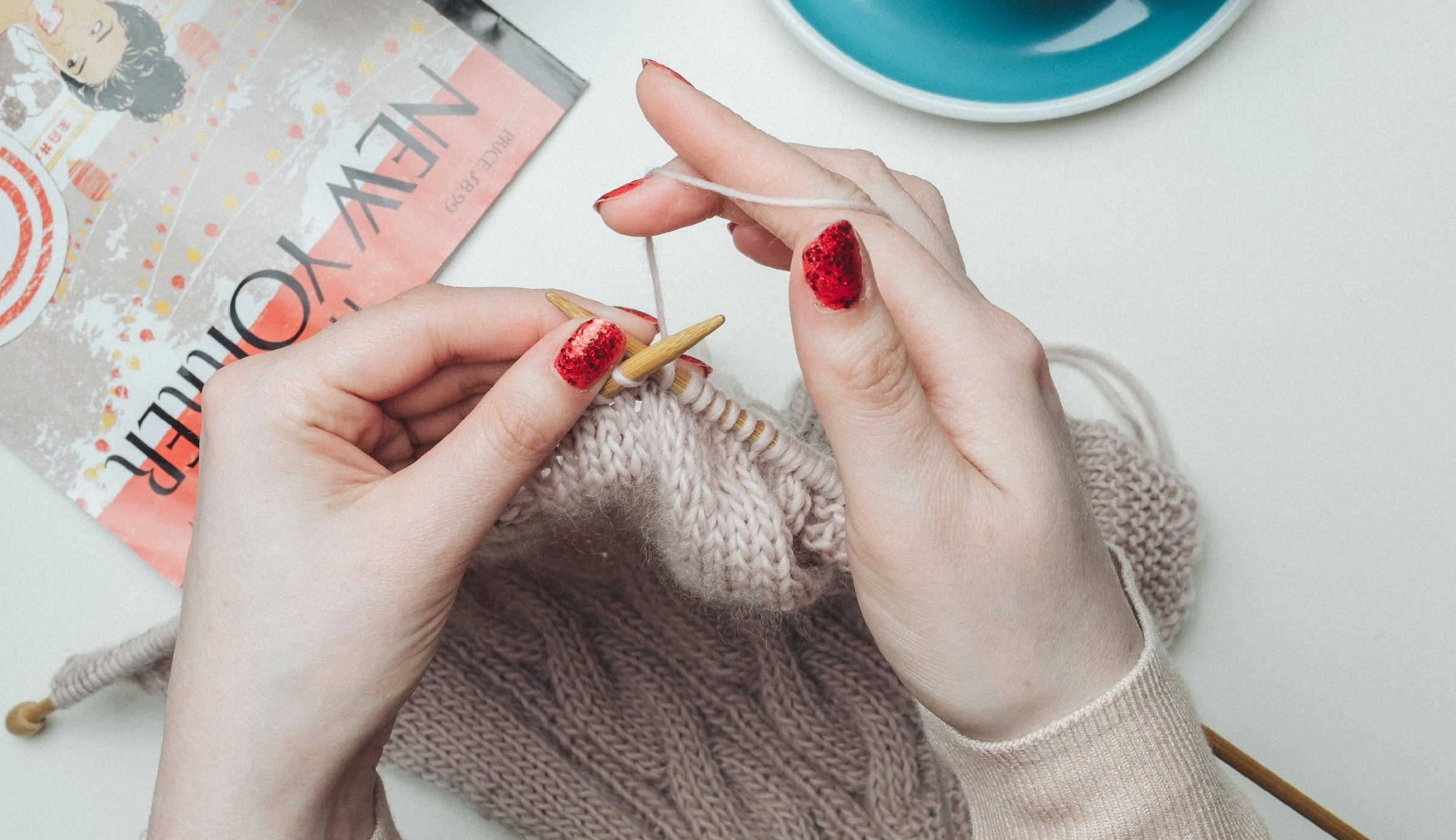
3 “Soft” Skills Every Beginner Knitter Should Learn
The world of knitting is a huge place full of potential rabbit holes when you’re a beginner. There’s always some new stitch pattern to try out or new garment construction you want to learn to create. However, there are also some valuable skills that a beginner knitter needs that deal with more than just wrapping yarn around the needles. These are the “soft” skills of the knitting world, if you will.
These three skills were crucial to leveling up my abilities as a young knitter, and I have a sneaking feeling they may be useful to other beginners as well!
Learn to Read Your Knitting
When I was a beginner knitter, working a pattern was always a tightrope act. As long as I followed it exactly as written and never lost my place, things would go just fine. But if my concentration dropped for even one minute? Completely floundering in absolute chaos.
That’s a stupidly stressful (and, might I add, completely unnecessary) scenario for such a relaxing hobby, so the number one soft skill I recommend to beginner knitters is getting better at reading your knitting.
When we talk about “reading” our knitting, there are actually a couple of different concepts at play:
Identifying stitches: The most basic form of reading your knitting is learning to identify knit stitches and purl stitches, whether they’re currently on the needles or they have already been knit off. This is the skill I had to learn to get off the tightrope and learn to actually chill out when I was knitting.
Identifying mistakes: This is like the college-level English course of reading your knitting. It’s one thing to be able to identify knits and purls, but it’s completely different to be able to look at your fabric and say, “Oops, that was supposed to be a knit, not a purl!”
As far as identifying stitches go, this is a form of reading your knitting that you can begin immediately. Pick up any finished object or WIP and start looking for those telltale stitch signs:
Knit stitches look like the letter “V”.
Purl stitches look like horizontal bars of yarn.
Identifying mistakes is a bit trickier. It requires you to be able to compare what you’re reading in the pattern to what you’re seeing on the needles, and that’s admittedly not a particularly easy skill to develop. This is something I don’t recommend rushing or trying to tutorial your way through: the concept will stick in your mind better through repeated real-world exposure.
From time to time, stop knitting and take a look at your progress. Without trying to diagnose exactly what’s wrong, does anything look “off” in the fabric? That’s the first step to identifying (and fixing!) mistakes.
Learn to Choose Yarns Based on Qualities, Not Just Weight
Modern knitting patterns will almost always suggest a yarn weight for you, and while that may be useful information, it’s not the complete story. Qualities like fiber type and how the yarn is spun will also have a major impact on your finished objects.
As a beginner, learning all the nuances of different yarns can seem overwhelming, but it’s not like you have to master everything in one go. Start with one simple, opinion-based aspect: how do I like the feel of this yarn?
Take a trip to your local yarn or craft store and do some yarn squishing. Specifically seek out different fiber types (wool, cotton, acrylic, etc.) and compare how much you like the feel of each. This might seem a little silly, but it’s actually important research that a lot of knitters never stop to consider–they just pick the exact brand of yarn recommended in the pattern without considering if it’s actually a good choice for the project or a good choice for them personally.
If you hate the feel of acrylic, then it’s probably not smart to invest hours into knitting an acrylic sweater!
After you start to get a feel for your own personal yarn preferences, you can start to expand into the more objective aspects of yarn:
Does this yarn stretch out over time?
How hard-wearing is this fiber type?
Is this yarn stiff or drapey?
How dense and heavy are these fibers?
There’s no one ideal yarn for every knitting project in the world; different finished objects require different yarn qualities. And you can absolutely learn what qualities thrive in which scenarios. Knowing when to break out the cashmere versus the cotton will noticeably improve your long-term satisfaction with your knitting projects.
Learn What’s Essential and What’s Not in Patterns
As a knitting pattern writer, I have a bit of a confession: we’re not knitting gods. While logically that probably comes as no surprise, beginning knitters do have a tendency to treat the instructions in a pattern as the law. I’m not going to imply that knitting patterns are useless or that knowing how to follow instructions isn’t valuable for a knitter, but a skilled, experienced knitter absolutely knows when and how to bend the rules.
Some instructions in a pattern genuinely shouldn’t be messed with. For example:
Arbitrarily removing stitches or rows from a stitch pattern: It might seem like a smart idea if you need to size something down, but you’re likely to turn a beautiful, carefully considered design into an incomprehensible mess.
Major changes to the construction of a garment: Doing something like converting a set-in sleeve sweater into a raglan might seem like a stylistic choice, but major construction changes like this are likely to have downstream consequences that you won’t anticipate. Ask me how I know. Go on, Ask. Me. How. I. Know.
That being said, there are plenty of places where customization is not only warranted, it’s basically necessary.
For example, sleeve and torso length in sweaters is a scenario where you should pay attention to your body over the pattern. Even a well-written, well-sized pattern has to appeal to the average body in some places, but what if you don’t have average-sized arms or an average-sized torso? Following the pattern instructions to the letter of the law is going to result in a sweater that doesn’t fit you properly.
There are any number of ways to approach learning knitting, and I don’t think that knitters, whether beginners or more advanced, should stop learning and experimenting with more technical knitting skills. But if you’re struggling to synthesize these technical skills into an actual finished object, take some time to practice the softer stuff too.